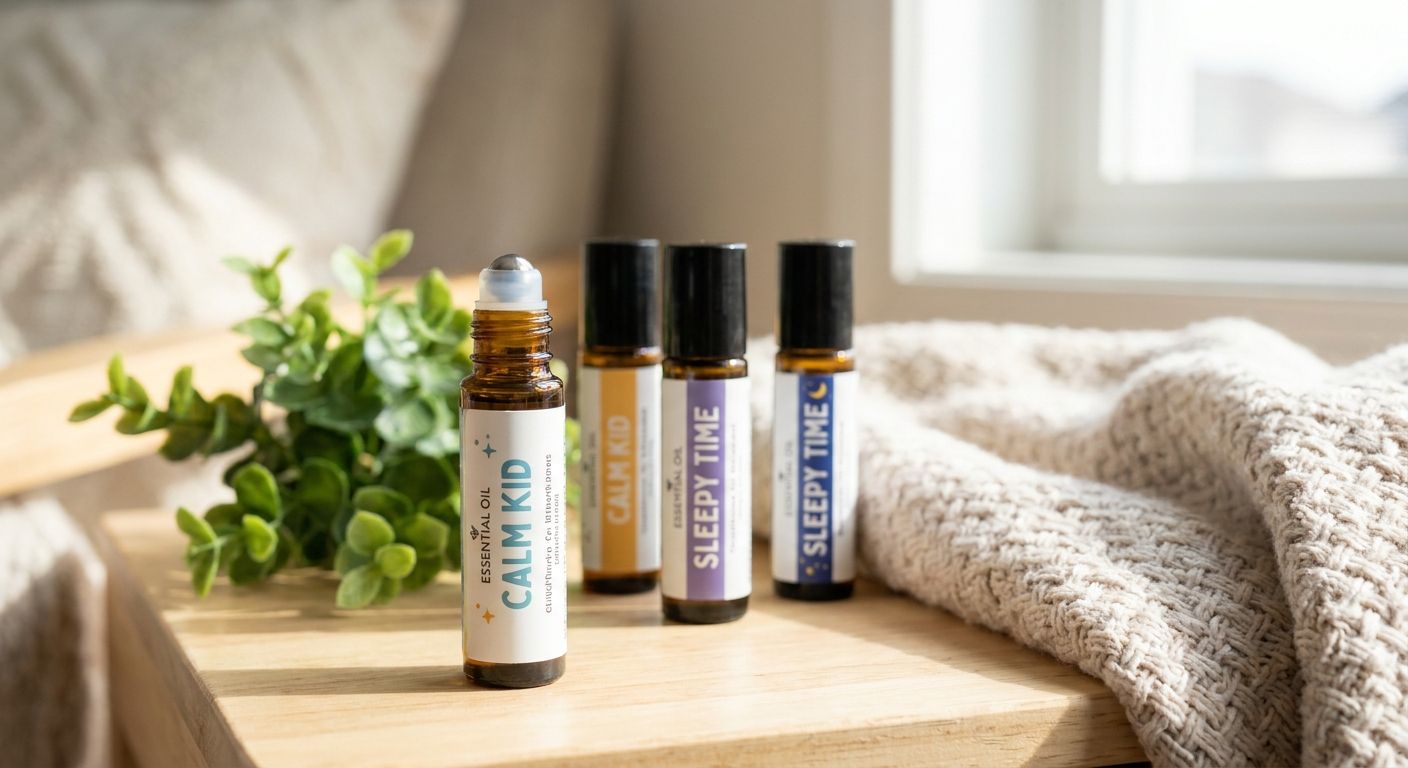
Most "kid-safe" essential oil roll-ons on store shelves are just adult blends with a friendlier label — and that gap is exactly where parents get burned. This guide breaks down what actually makes an essential oil roll-on for kids safe, by age, dilution, and oil type.
- A true essential oil roll on for kids needs a dilution of 0.25%-1% for ages 2-6 and 1%-2% for ages 6-12 — anything stronger is an adult product.
- Skip neat (undiluted) oils and phototoxic citrus oils on kids under 12 without guidance from a pediatrician.
- Roll-on format beats diffusers for control and dosing accuracy with young children in 2026 — you know exactly what touched the skin.
- Rooted for Good's essential-oil roll-on for anxious moments is built for older kids and teens managing stress, not toddlers.
- Pair any roll-on routine with a gentle, fragrance-transparent soap for kids with eczema-prone skin.
Why this matters
Essential oils are concentrated plant chemistry, not a gentler version of scented lotion. A drop that's fine on an adult wrist can be too much for a toddler's skin, which absorbs faster and has a higher surface-area-to-body-weight ratio.
Parents searching for an essential oil roll on for kids in 2026 are mostly trying to solve for bedtime, meltdowns, or a scraped knee without reaching for synthetic fragrance. That's a reasonable goal. It just requires reading a label the way you'd read a supplement label, not a candle label.
Rooted for Good builds its roll-on and skincare lines around ingredient transparency and small-batch dilution, and 10% of every purchase goes toward feeding children and families in need — which matters if you're already thinking hard about what goes on your kid's skin and where your money goes after that.
Who this is for
This guide is for parents and caregivers of kids roughly ages 2 through teens who want a topical, roll-on format instead of a diffuser, and who are comparing pre-made blends against DIY dilution. It is not a substitute for a pediatrician's advice if your child has asthma, eczema flares, or a known sensitivity to plant oils.
What to look for in an essential oil roll-on for kids
Dilution rate stated on the label
If a roll-on doesn't state its dilution percentage, you cannot verify it's appropriate for a child. Reputable aromatherapy guidance puts child-safe dilution at 0.25%-1% for ages 2-6 and 1%-2% for ages 6-12 — well below the 2%-5% range common in adult blends.
Oils excluded from the blend
Certain oils carry documented risks for young children: eucalyptus and peppermint can affect breathing in kids under 6, wintergreen and camphor are toxic in small doses, and citrus oils can cause phototoxic reactions in sunlight. A kid-appropriate roll-on should name what's excluded, not just what's included.
Roll-on format over diffuser or spray
A roll-on puts a fixed, small amount directly where you want it — pulse points, temples, the bottoms of feet. A diffuser fills a whole room with no dosing control, which matters more with a child's smaller airway. For kids, format is a safety feature, not just a preference.
Carrier oil quality
The essential oil is only part of the formula — the carrier oil (jojoba, fractionated coconut, sweet almond) is what actually touches most of the skin. A cheap mineral-oil carrier can clog pores or irritate eczema-prone skin, which matters if your child already deals with dry or reactive patches.
Age-appropriate labeling
"All natural" is not the same as "safe for a 4-year-old." Look for a blend that states a minimum age, ideally 2 years and up, and treats infants under 3 months as off-limits entirely — a standard most aromatherapy educators hold to regardless of brand.
Scent purpose matched to the moment
A calming lavender-and-chamomile roll-on for bedtime does a different job than a bright citrus blend meant for morning energy. Buying a roll-on without matching the scent profile to the actual moment (meltdown, bedtime, focus) is how bottles end up unused in a drawer.
Top picks for families choosing a roll-on
The tween-and-teen calm-down pick. Rooted for Good's essential oil roll-on for anxious moments is built around a pre-diluted format meant for quick application during stressful moments — think test anxiety or a rough morning before school. This is not a toddler formula; treat it as appropriate for kids roughly 10 and up who can describe how a scent makes them feel. Consider for tweens and teens; Skip for kids under 8.
The sensitive-skin pairing. If your child already deals with eczema flares, a roll-on routine works better alongside a fragrance-transparent cleanser. Rooted for Good's natural soap for eczema-prone skin is formulated for reactive skin types and pairs with a light-touch roll-on rather than fighting against it. Buy if your child has diagnosed eczema and you're building a full routine, not just a single product.
The DIY toddler blend. For kids under 6, the safest route is often a single, well-documented oil like lavender diluted at 0.5% in a carrier oil, applied to feet or a stuffed animal rather than skin directly. This isn't a purchase pick — it's the fallback when no pre-made blend states a dilution low enough for a toddler. Consider if you want full control over concentration; Skip pre-made blends with no stated percentage.
What to avoid
- "Kid-friendly" blends with no dilution percentage on the label. If the brand won't state it, assume it's formulated for adults.
- Roll-ons marketed as "pure" or "undiluted." Neat application on a child's skin is a common cause of reactions, even with oils considered gentle for adults.
- Citrus-heavy blends for daytime outdoor use. Phototoxic reactions from oils like bergamot or lemon show up hours after sun exposure, not immediately, which makes them easy to miss until it's too late.
Verdict comparison
| Pick | Best age range | Format | Verdict |
|---|---|---|---|
| Calm-down roll-on for anxious moments | 10+ | Pre-diluted roll-on | Consider |
| Eczema-prone skin soap pairing | All ages with eczema | Bar soap | Buy |
| DIY lavender-in-carrier blend | 2-6 | DIY roll-on | Consider |
| Neat/undiluted essential oils | Not recommended for kids | Bottle | Skip |
FAQ
What's the best essential oil roll on for kids?
The best essential oil roll on for kids in 2026 is one that states its dilution percentage on the label, at 0.25%-1% for ages 2-6 and 1%-2% for ages 6-12. A blend with no stated dilution should be treated as an adult product regardless of marketing.
Is essential oil roll-on safe for a 3-year-old?
Yes, if the dilution is 0.25%-1% and the blend excludes oils like eucalyptus, peppermint, and camphor. Apply to feet rather than the face, and patch test on the inner arm 24 hours before regular use.
How much does a kids' essential oil roll-on cost?
Roll-on blends generally run in the $15-$35 range depending on size and ingredient sourcing. Price alone doesn't indicate safety for children — check the dilution statement first.
Are diffusers or roll-ons safer for kids?
Roll-ons give more dosing control because you apply a fixed, small amount to a specific spot. Diffusers disperse oil into the air with no way to measure exposure, which is riskier for a child's smaller airway.
What essential oils should never be used on young children?
Eucalyptus, peppermint, wintergreen, and camphor are the oils most commonly flagged for children under 6 due to breathing and toxicity concerns. Citrus oils also carry phototoxicity risk before sun exposure.
Can essential oil roll-ons help with a child's anxiety?
Calming scent profiles like lavender and chamomile are commonly used to support relaxation in kids, though a roll-on is a comfort tool, not a treatment. For persistent anxiety, talk to a pediatrician alongside any scent-based routine.
At what age can a child start using essential oil roll-ons?
Most aromatherapy educators recommend waiting until at least 2 years old, and treating infants under 3 months as off-limits for topical essential oil use entirely. Between 2 and 6, keep dilution at 0.25%-1%.
Do I need to patch test every new roll-on blend?
Yes, every time, even if a previous blend from the same brand worked fine. Apply a small amount to the inner forearm and wait 24 hours before using it on the face, feet, or pulse points.
One last thing
The detail most parents miss: a blend can be labeled "natural" and still carry a higher essential oil concentration than the adult roll-on sitting next to it on the shelf. Dilution percentage, not the ingredient list, is the number that actually protects a child's skin — check it before the scent, before the packaging, before the price.